.png)
1. Modern Times (1936) | Charlie Chaplin

Introduction:
Modern Times (1936) is one of the most famous films of the 20th century. It was directed, written, and produced by Charlie Chaplin. Although it was released when sound films were becoming popular, Modern Times remains largely a silent film. The movie shows the social and economic problems of the early 20th century, especially during the Great Depression.
Through his famous character, the Little Tramp, Chaplin shows how ordinary people suffer because of industrialization, machines, and economic inequality. Even in difficult situations, the Tramp faces life with humor and hope. The film criticizes industrial capitalism while also celebrating the strength and spirit of human beings.
Overview of the Movie Modern Times:
Modern Times (1936), directed and produced by Charlie Chaplin, is a silent film that reflects the social and economic problems of the early 20th century, especially during the Great Depression. Through his famous character, the Little Tramp, Chaplin presents the struggles of ordinary people living in a rapidly industrialized world. The film uses humor and visual storytelling to criticize a society dominated by machines and industrial capitalism.
The story focuses on the Little Tramp’s life as a factory worker, where repetitive and mechanical labor affects his health and individuality. Scenes like the feeding machine experiment highlight how technology and efficiency are valued more than human dignity. Chaplin shows that industrialization often reduces humans to machine-like workers, leading to mental stress and loss of freedom.
The film also portrays unemployment and poverty, major issues of the Great Depression. After losing his job, the Tramp struggles to survive and ironically finds peace in prison because it provides basic needs. The character of the Gamin, a homeless young girl, represents the suffering youth of the time. Together, they dream of a simple and secure life.
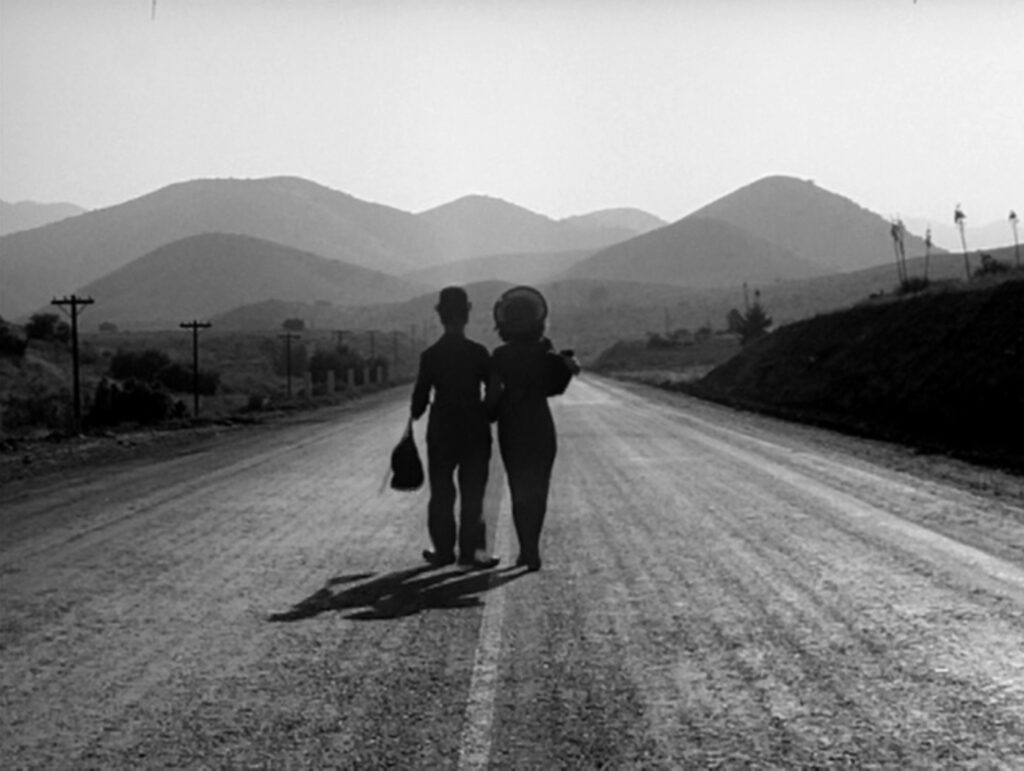
The final scene, where the Tramp and the Gamin walk towards an open road, symbolizes hope and resilience. Despite uncertainty, they move forward with courage. Overall, Modern Times is a powerful social commentary that criticizes industrial society while celebrating the strength and endurance of the human spirit.
What is Frame Study?
Frame study is a method of film analysis that focuses on closely examining individual scenes or visual frames. Each frame is studied to understand its deeper meaning, message, and connection to the film’s themes and historical background. By analyzing visual elements such as images, movement, symbols, and composition, frame study helps viewers understand how films communicate ideas even without dialogue.
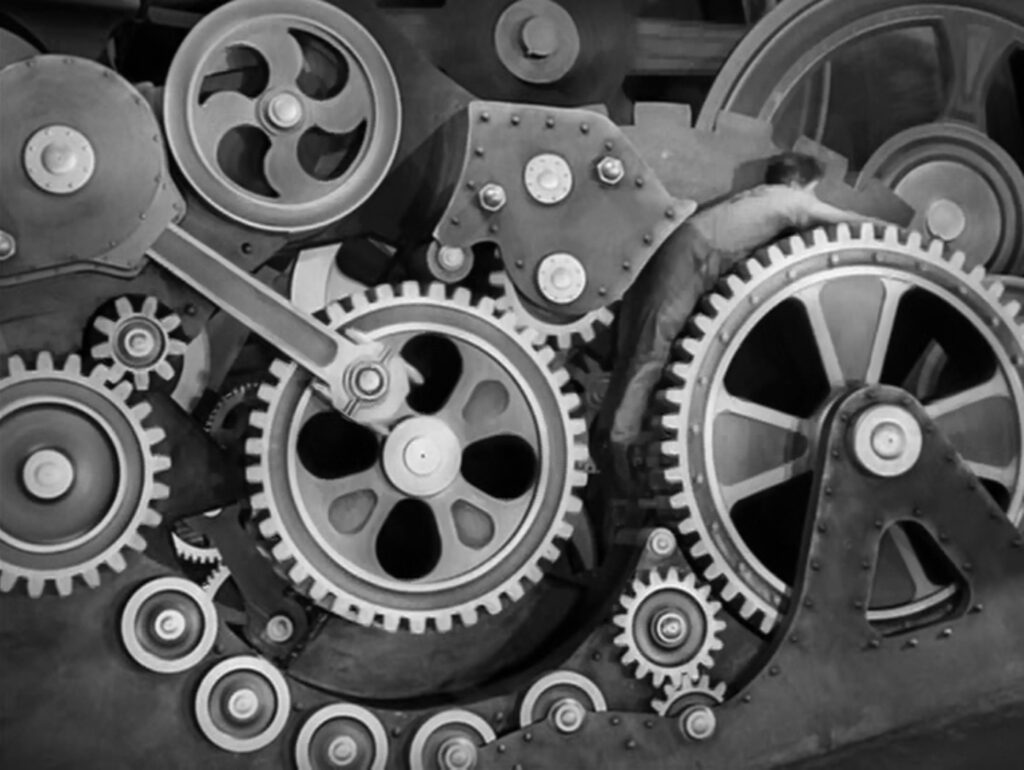
In Modern Times, frame study is especially important because Charlie Chaplin relies mainly on visual storytelling. As a largely silent film, every frame carries strong meaning. For instance, the scene in which the Little Tramp is trapped inside a machine powerfully shows how industrialization turns humans into mechanical parts, highlighting the loss of human dignity in a machine-driven society.
Frame study also helps relate the film to the socio-economic conditions of the 20th century, particularly the Great Depression. The final frame of the open road, where the Tramp and the Gamin walk forward together, symbolizes hope and resilience despite hardship. Through such meaningful frames, Modern Times becomes not only a work of art but also a strong social commentary on history and human life.
Frame 1: Sheep and Workers – Birth of the Mass Man


Explanation:
The film opens with sheep moving as a compact herd, followed immediately by workers entering the factory in the same manner. This is not a casual visual joke; it is a symbolic statement about modern society. Chaplin suggests that industrial civilization replaces independent individuals with a controlled mass.
A. C. Ward notes that the 20th century witnessed the rise of mass systems factories, bureaucracies, corporations that demanded conformity. In this frame, workers have no personal identity; they are bodies moving according to the rhythm of the industrial clock. The image reveals how modern life conditions people to obey systems unquestioningly, much like sheep following a flock.
This frame introduces the central tragedy of modernity: progress achieved through the loss of individuality.
Frame 2: Assembly Line Labor – Mechanization of the Human Body
Explanation
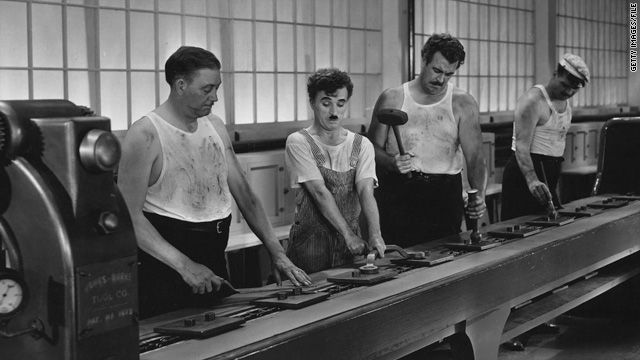
Chaplin’s character tightens bolts endlessly on an assembly line. The action is repetitive, rapid, and meaningless. Gradually, his body begins to move automatically, even outside the factory. This scene shows that the machine does not merely control labor it reprograms the human body itself.
Ward describes the modern age as one where humans experience alienation, a separation from meaningful work and self-expression. Chaplin visually demonstrates this alienation. The worker no longer controls his actions; the logic of the machine has entered his nervous system.
This frame critiques mass production for destroying craftsmanship and creativity. The worker does not understand the product; he only performs a fragment of labor endlessly. The scene embodies the modern fear that human beings are becoming extensions of machines.
Frame 3: Inside the Gears – Human Life Absorbed by the System

Explanation
One of the most striking images in Modern Times shows Chaplin physically trapped inside giant gears. This image is symbolic rather than realistic. It represents how modern industrial systems absorb human life completely.
A. C. Ward argues that modern civilization reduces individuals to functional units within vast systems. Chaplin literalizes this idea: the worker’s body becomes part of the machinery. There is no distinction between human flesh and metal gears.
This frame expresses the central anxiety of the 20th century that technological and economic systems have grown so powerful that humans exist only to serve them. The image suggests a terrifying reversal: machines no longer serve people; people serve machines.
Frame 4: The Feeding Machine – Capitalism’s War on Human Time


Explanation
The feeding machine is designed to eliminate lunch breaks so workers can continue producing without interruption. This scene exposes capitalism’s obsession with efficiency and profit. Even eating, a basic human need, is treated as wasted time.
Ward explains that modern life is ruled by mechanical time, where every moment must be productive. Chaplin shows how this logic dehumanizes workers. The feeding machine does not care whether the worker is comfortable or safe; it exists only to increase output.
This frame critiques the false promise of technological progress. Technology, instead of liberating humans, becomes a tool of control. The scene reveals capitalism’s deeper cruelty: it values production more than people.
Frame 5: Prison as Stability – Collapse of Economic Justice


Explanation
In one of the film’s most ironic moments, Chaplin finds that prison offers food, shelter, and routine things denied to him in free society. This inversion exposes the moral failure of the economic system.
A. C. Ward notes that the early 20th century, particularly during the Great Depression, revealed the fragility of capitalist promises. Economic systems produced wealth but failed to distribute it fairly. Chaplin suggests that a society in which prison offers security while freedom offers hunger is fundamentally unjust.
This frame highlights poverty, unemployment, and inequality. It asks a disturbing question: What is the value of freedom in a society that cannot guarantee survival?
Frame 6: Life on the Streets – Poverty Amid Progress

Explanation
Chaplin wandering the streets unemployed reflects the harsh reality of modern economic life. Despite factories, machines, and national wealth, individuals remain homeless and hungry.
Ward describes the 20th century as an age of contradictions technological advancement alongside human misery. This frame visually represents that contradiction. The city is modern, yet life within it is insecure.
Chaplin shows that capitalism creates abundance without justice. Progress exists, but it does not reach everyone. This scene reflects the lived experience behind many 20th-century literary works that focus on social realism and working-class suffering.
Frame 7: The Dream of a Home – Fragile Human Hope


Explanation
Chaplin and the Gamin dream of a simple home, food, and peace. Their dream is modest, yet almost impossible to achieve. This contrast reveals the emotional cost of poverty.
Ward notes that modern life often produces disillusionment the gap between expectation and reality. Chaplin shows that even basic dreams are denied to the poor. Yet the dream itself matters. It shows that humanity survives despite oppression.
This frame adds emotional depth to the film. It suggests that hope persists even when systems fail. Chaplin reminds us that the human spirit resists complete domination.
Frame 8: Police and Authority – Early Signs of Authoritarian Control


Explanation
Chaplin is repeatedly chased and arrested by police, often without clear wrongdoing. Authority appears rigid, impersonal, and unsympathetic.
A. C. Ward explains that the modern age saw the expansion of institutional power. This frame reflects how systems control individuals rather than protect them. While Modern Times does not show dictators directly, it reveals the same mentality: discipline, surveillance, and punishment.
The poor are treated as problems to be managed, not humans to be helped. This prepares the ground for understanding dictatorship in The Great Dictator, where such power becomes openly violent.
2. The Great Dictator (1940) | Charlie Chaplin

Introduction
Charlie Chaplin’s The Great Dictator (1940) is one of the most courageous and influential films in cinematic history. Released at the beginning of World War II, the film boldly criticizes the rise of totalitarian regimes in Europe, especially Adolf Hitler’s Nazi Germany and Benito Mussolini’s Fascist Italy. At a time when many filmmakers avoided political risk, Chaplin used satire and humor as powerful tools to expose the cruelty, arrogance, and inhumanity of dictatorship. More than simple entertainment, the film raises urgent questions about freedom, humanity, and moral responsibility. As both an artistic masterpiece and a political statement, The Great Dictator remains a timeless warning against authoritarian power.
Overview of the Movie The Great Dictator
The Great Dictator is a satirical comedy-drama built around two parallel characters played by Chaplin himself: Adenoid Hynkel, the dictator of the fictional country Tomainia, and a poor Jewish barber who becomes a victim of oppression. Hynkel is a sharp caricature of Adolf Hitler, portrayed as childish, narcissistic, and obsessed with power. Through exaggerated gestures and comic situations, Chaplin exposes the absurdity and danger of authoritarian leadership.
In contrast, the Jewish barber represents innocence, humanity, and suffering under tyranny. Mistaken for Hynkel near the end of the film, he unexpectedly becomes a voice of truth and conscience. The famous final speech delivered by the barber abandons satire and directly appeals to human values such as peace, equality, and compassion. Iconic scenes like Hynkel’s dance with the globe balloon symbolize the fragile and delusional nature of dictatorial ambition. By blending humor with serious social criticism, the film powerfully condemns hatred, propaganda, and political oppression.
What is Frame Study?
Frame study is a method of film analysis that closely examines individual scenes or visual frames to understand their deeper meanings. Each frame is analyzed in terms of composition, movement, symbolism, and socio-political context. This approach helps viewers recognize how visual images communicate complex ideas, emotions, and messages beyond spoken dialogue.
In The Great Dictator, frame study reveals how Chaplin uses visual satire to challenge authoritarianism. For example, the frame of Hynkel joyfully playing with the globe highlights the dictator’s desire to control the world, while also showing the foolishness and instability of such power. Similarly, the final frame of the barber’s speech transforms cinema into a moral platform, urging humanity to reject hatred and embrace freedom.
Through frame study, The Great Dictator can be understood not only as a film but as a powerful socio-political document. Chaplin’s use of humor, symbolism, and visual storytelling demonstrates how cinema can resist tyranny and inspire hope, even during the darkest moments of history.
Frame 1: The Jewish Barber’s Shop – Ordinary Life Before Political Violence


Explanation
This frame introduces the Jewish barber as a gentle, hardworking, and apolitical man who lives a quiet, honest life. His barbershop symbolizes everyday human existence arning a living through skill, maintaining personal dignity, and participating peacefully in society. Chaplin carefully constructs this calm setting to remind viewers that before the rise of dictatorship, life for many people was simple and humane.
A. C. Ward notes that the 20th century witnessed the intrusion of political ideology into private and personal spaces. The barber poses no threat to the state, yet he becomes a target solely because of his identity. This reflects how totalitarian regimes redefine citizenship based on race, religion, or loyalty rather than humanity. Chaplin shows that dictatorship does not begin with violence alone; it begins by destroying security, trust, and normal life, turning ordinary spaces like a barbershop into places of fear and vulnerability.
Frame 2: Storm Troopers Destroying the Ghetto – Institutionalized Oppression


Explanation
In this frame, we see storm troopers systematically vandalizing homes, breaking windows, and terrorizing ordinary civilians. The violence is cold, organized, and impersonal, emphasizing that the machinery of dictatorship relies on mechanized cruelty rather than spontaneous aggression. Chaplin carefully composes the frame to highlight the uniformity of soldiers versus the vulnerability of civilians, showing the imbalance of power.
A. C. Ward notes that the 20th century was marked by centralized authority and bureaucratic control, similar to industrial systems. Here, individuals act as instruments of the state, stripped of conscience. The frame critiques how regimes isolate, label, and dehumanize minority communities, creating a visual metaphor for oppression under nationalism and political ideology.
Frame 3: Hynkel’s Public Speeches – Language as a Weapon


Explanation
This frame captures Hynkel delivering an exaggerated, forceful speech to a cheering crowd. His facial expressions, body language, and invented language amplify the emptiness behind his words. Chaplin’s framing emphasizes the gap between the leader’s performative gestures and the intellectual engagement of the audience, showing how spectacle dominates reason.
Ward observes that mass societies in the 20th century were particularly susceptible to propaganda and emotional manipulation. This frame demonstrates how language is used as a tool of domination, controlling not through logic but through fear, repetition, and theatrical display. The visual power lies in the contrast: one authoritative figure versus a passive, manipulated crowd.
Frame 4: The Globe Dance – The Psychology of Dictatorship


Explanation
In this silent, iconic frame, Hynkel plays with a large, inflated globe, spinning it as if he controls the world. The exaggerated gestures and dreamlike choreography visually communicate megalomania, fantasy, and delusion. Chaplin isolates the globe and dictator in the frame, symbolizing ego-driven obsession and detachment from reality.
According to Ward, 20th-century dictators often believed themselves as destiny-makers, detached from moral responsibility. The frame’s dramatic irony highlights the fragility of such power: the globe bursts, symbolizing the ultimate failure of unchecked ambition. It critiques the illusion of control, showing that dictatorships rely on appearances and belief rather than substantive authority.
Frame 5: Concentration Camp Imagery – Loss of Human Identity


Explanation
This frame shows prisoners lined up, monitored, and stripped of personal identity. Chaplin’s camera focuses on uniformity, order, and the anonymity of individuals, emphasizing psychological oppression rather than explicit violence. Shadows, lines, and symmetry visually reinforce the dehumanization.
Ward notes that the 20th century saw ethical collapse under extreme political ideologies. Chaplin’s frame demonstrates how human beings are reduced to numbers and categories, highlighting the machinery of fear. The power of this frame lies in its suggestion of suffering: oppression is not just physical; it is a systematic stripping of dignity, autonomy, and individuality.
Frame 6: Mistaken Identity – Power as Performance


Explanation
Here, the barber is confused for Hynkel, visually contrasted with the dictator’s regalia and posture. Chaplin’s framing emphasizes the role of symbols, uniforms, and appearances in maintaining authority. Even a regular citizen can “perform” the dictator’s role if the symbols are in place, suggesting the artificiality of power.
Ward observes that modern authority often lacks intrinsic moral foundation. This frame highlights how power survives not through merit or morality but because people accept, fear, or reinforce its symbols. Chaplin uses comedy to critique authority, showing that the trappings of dictatorship gestures, speech, uniform are performative, not inherent.
Frame 7: Benzino Napaloni – Parody of Mussolini and Posturing of Authority


Explanation
In this frame, we see Benzino Napaloni, the absurd, exaggerated dictator of Bacteria a clear parody of Benito Mussolini. He is often shown gesturing dramatically, puffing out his chest, and performing exaggerated acts of bravado. Chaplin draws him as almost clownishly arrogant, yet dangerous, capturing how real‑world authoritarian figures used showmanship, bravado, and public performance to manipulate and control people. This frame is significant because it highlights how dictatorship is not just about tyranny, but about performance of power. Napaloni’s behavior grandiose speeches, theatrical poses, frantic gestures shows that much of authoritarian control depends on symbolic posturing and intimidation rather than moral authority or genuine leadership.
A. C. Ward describes the 20th century as an era where political leadership increasingly relied on mass spectacle and personality cults. Dictators like Mussolini and Hitler did not simply rule through force; they crafted elaborate public images, using rallies, speeches, and media to foster a sense of awe and unquestioned obedience. Napaloni’s exaggerated demeanor in this frame visually represents that mechanism: authority constructed through performance and propaganda rather than substantive governance.
Frame 8: Final Speech – Humanism as Resistance


Explanation
The final frame shows Chaplin addressing the camera directly, breaking from satire into a humanist plea. His gesture, gaze, and composed delivery visually reinforce sincerity and moral clarity. The frame composition isolates Chaplin, making him both an individual and a universal voice for humanity.
Ward emphasizes that literature of the 20th century often engaged directly with moral and ethical questions, aiming to defend human values against mechanization, bureaucracy, and tyranny. In this frame, Chaplin urges compassion, democracy, and resistance to oppression. It shows the power of the individual conscience against collective manipulation and tyranny, highlighting the enduring need for moral courage in the modern world.
References :
1. A. C. Ward. Twentieth Century Literature. Shubhi Publications, 2015.

No comments:
Post a Comment